polymers-hero-desktop
polymers-hero-mobile

Thin-Film Polymer Processing: How LCI Systems Improve Polymer Manufacturing

Thin-film polymer processing is a continuous manufacturing method in which rotor blades spread polymer melt into a thin, constantly renewed film on a heated wall — enabling rapid devolatilization, polycondensation, and finishing of polymers up to 15,000,000 centipoise. LCI Corporation's VISCON® and FILMTRUDER® systems use this principle to deliver higher product quality, lower residual monomers, and improved process efficiency than conventional extruders, stirred tanks, and pipe reactors.

The Processing Challenge

Why high-viscosity polymer manufacturing is so difficult

High-viscosity polymer manufacturing is difficult because viscosity amplifies every processing challenge simultaneously. As viscosity rises, heat transfer efficiency drops, volatile removal by diffusion slows, residence time must extend — degrading heat-sensitive materials — and power demand rises sharply. Beyond approximately 10,000 to 100,000 centipoise, conventional equipment reaches the limits of its operating range, and standard multi-step processing trains multiply cost and complexity without solving the underlying physics.

Heat transfer efficiency drops

Conventional equipment transfers heat through vessel walls into the surrounding bulk polymer. As viscosity rises, the material insulates itself: heat cannot penetrate the melt uniformly, creating temperature gradients, hot spots, and inconsistent product properties. Effective processing at high viscosity requires maximum surface-to-volume contact — not bulk heating.


Failure zone: stirred tanks and jacketed pipe reactors above ~10,000 cP
Volatile removal stalls inside the melt

Monomers and solvents escape only by diffusing from within the polymer to the surface. In a dense, viscous melt with limited exposed surface area, diffusion distances become too long. The result is trapped volatiles that cannot be removed regardless of residence time. This is why conventional polystyrene devolatilization leaves approximately 350 ppm residual styrene — a quality ceiling the physics of bulk equipment cannot push through.


Root cause: inadequate surface area renewal in stirred tanks and pipe reactors

Long residence time degrades the product

Stirred tanks and jacketed pipe reactors compensate for poor heat and mass transfer by extending time at temperature. For heat- and shear-sensitive polymers, this is counterproductive: prolonged thermal exposure causes chain scission, discoloration, off-spec end groups, and degradation. The approach that overcomes poor transfer efficiency directly creates a new failure mode in the product itself.


Risk: thermal degradation in polycarbonate, polyamide, and engineering thermoplastics

Power demand rises non-linearly

Conventional mixers must work against the full apparent viscosity of the bulk material. As viscosity increases, resistance rises — and required drive power rises with it. Equipment sized for lower-viscosity operation runs out of motor capacity before processing targets are met. And because energy is distributed throughout the entire material mass rather than at the point of action, most of it generates heat rather than useful work.


Consequence: commercially impractical above 1,000,000 cP with conventional drives

What is thin-film polymer processing?

A design built around the polymer, not the equipment

Definition

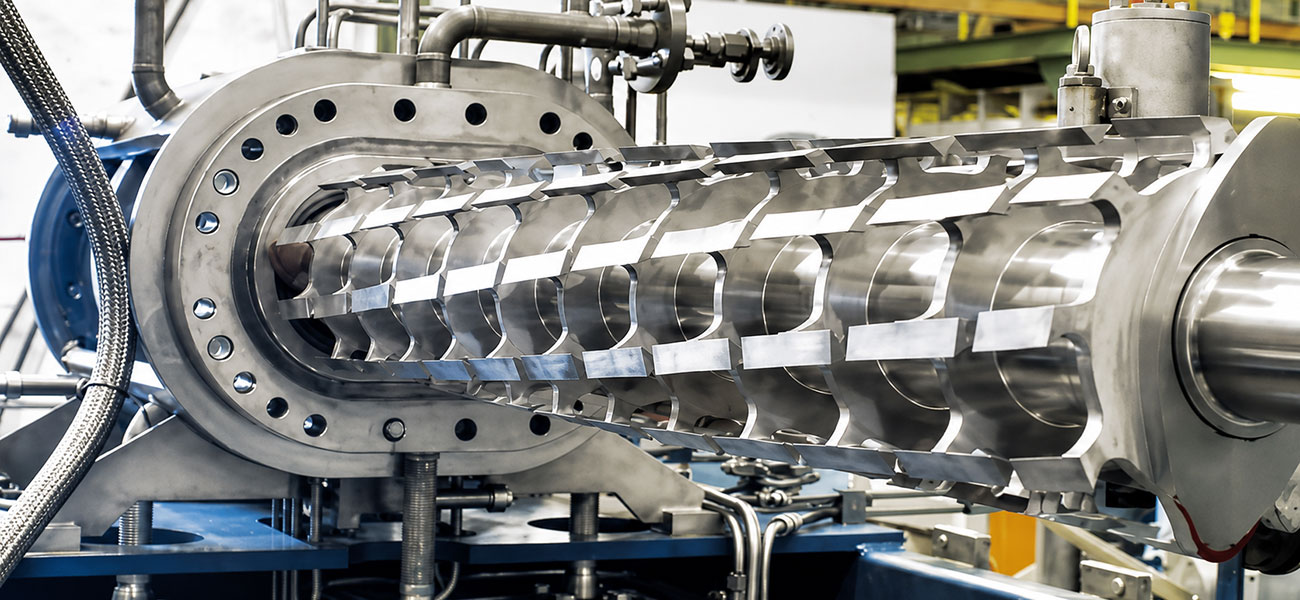
Thin-film polymer processing spreads high-viscosity melt or solution as a thin film along a heated cylindrical wall. Rotor blades continuously renew this surface multiple times per second, generating high heat and mass transfer rates while keeping residence time short and controlled. The method handles viscosities up to 15,000,000 centipoise — far beyond the range where stirred tanks or jacketed pipe reactors remain viable.

  • Operating pressure range: Vacuum to +150 psi
  • Surface renewal rate: Multiple/sec
  • Back-mixing: Near-zero
  • Processing mode: Single-pass
high-viscosity-processors-LCI
Process principle
Product enters above the heating zone
Feed distributes evenly across the inner wall. The vertical architecture uses gravity and the rotor together, not against each other.
Rotor blades form and convey the film 
Blades spread the polymer into a thin film and move it downward in a controlled helical path, continuously mixing and exposing fresh surface to the heated wall.
Vapors exit countercurrent (or co-current)
Released monomers and solvents travel countercurrent to the polymer flow and exit at the top. Co-current designs handle dilute feeds where entrainment is a risk.
4
Conical section discharges at pressure
The concentrated, high-viscosity product exits the conical discharge zone under pressures up to 4,000 psig, ready for direct downstream transfer.

Thin-Film Polymer Processing

Where conventional equipment stops, LCI begins.

Stirred tanks and pipe reactors have viscosity ceilings. LCI thin-film systems process polymer melts up to 15,000,000 centipoise with shorter residence times, lower residual monomers, and no thermal degradation.

Max viscosity: 15M cP

Residual styrene: <50 ppm

Solvent recovery: 98%+

LCI Thin-Film Systems

Two systems. Every viscosity.

VISCON® and FILMTRUDER® cover complementary viscosity ranges and run in series for processes that need both pre-concentration and final finishing in a single plant.

Pre-concentration & polycondensation

VISCON®

Up to ~100,000 cP

The VISCON® handles lower-viscosity feeds and mid-range polycondensation reactions. Plants commonly pair it upstream of a FILMTRUDER® — the VISCON® removes the bulk of solvent or monomer, then the FILMTRUDER® takes the pre-concentrated product to final specification. It also works as a standalone unit for PET polycondensation and phenolic resin concentration.

Max Viscosity
~100,000 cP
Flow Config
Co-current / countercurrent
Pressure Range
Vacuum to +150 psi
Heating
Steam or hot oil to 650°F

Typical applications: Polyester (PET), phenolic resins, epoxy resins, APP pre-concentration, SAN pre-stage, polyethylene wax concentration

High-viscosity finishing & devolatilization

FILMTRUDER®

100,000 cP to 10,000,000+ cP

The FILMTRUDER® handles materials that stop extruders cold. For polystyrene, it reduces residual styrene from ~10% to below 50 ppm in a single pass, versus the ~350 ppm typical of conventional devolatilization. When installed upstream of existing vented extruders, it increases plant throughput by a factor of two to three. For Nylon 6, it combines final reaction and devolatilization into one unit, eliminating extraction, drying, and washwater stages entirely.

Max Viscosity
10,000,000+ cP
Discharge Pressure
Up to 4,000 psig
Residual Monomer (PS)
<50 ppm
Throughput Uplift
2–3× vs extruder

Typical applications: ABS, polystyrene, nylon-6, silicone rubber, SAN, styrene-acrylonitrile, polyester (PBT), atactic polypropylene finishing

polymers-brochure-dowload

Download the Brochure

Thin-Film Polymer Processing for High-Performance Materials

From Evaporation and Particle Formation to Safe Dust Capture and Containment

Download the Brochure

Technology Comparison

How LCI thin-film compares to conventional approaches

Three process characteristics determine polymer quality at high viscosity: surface-to-volume ratio, residence time control, and back-mixing. This is where the difference is measurable.

CharacteristicLCI Thin-Film SystemStirred Tank ReactorJacketed Pipe / Static Mixer
Surface-to-volume ratioVery highLowModerate
Residence timeShort, narrow distributionLong, broadLong
Pressure dropVirtually noneModerateLarge
Back-mixingNegligibleHighModerate
Surface renewalMultiple times per secondSlow, intermittentContinuous but slow
Viscosity ceiling15,000,000 cP~5,000–10,000 cP~50,000 cP
Thermal degradation riskVery lowHighModerate to high
Processing modeContinuous, single-passBatch or semi-batchContinuous, multi-pass

Core Applications

Four process challenges, one equipment family

LCI systems operate across the full polymer production chain — from concentration through polycondensation to final finishing and solvent recovery.

Concentration & Devolatilization

Removes monomers and solvents from polymer melts where surface renewal rates far exceed what stirred tanks or extruders achieve at equivalent viscosity. Residuals reach single-digit ppm without multiple processing stages.

Polyethylene Polypropylene Polystyrene Polycarbonate PVA Epoxies

Polymerization & Polycondensation

Removes condensation by-products immediately as they form, shifting reaction equilibrium toward higher molecular weight continuously. Near-zero pressure drop and short residence time produce consistent end groups and tight molecular weight distributions across grades.

Polyesters (PBT/PET) Phenolics Styrenics Acrylics SAN

De-monomerization & Finishing

Final processing for polymers requiring very low residual monomer for regulatory compliance or product specification. Combines reaction and devolatilization in one unit, eliminating the separate extraction and drying equipment that conventional finishing lines require.

Nylon-6 PolystyreneABSPVASANSilicone rubber ABS PVA SAN Silicone rubber

Solvent & Material Recovery

Recovers solvents, monomers, and marketable polymer from dilute feeds that conventional incineration-based processes write off. Atactic polypropylene streams at 5% polymer in 95% solvent reach 99% total solids, recovering more than 98% of the solvent.

Atactic PP Polyethylene wax Polymeric residues Caprolactam

Mastering High-Viscosity Polymer Processing

Processing high-viscosity polymers is complex. Controlling quality, removing volatiles, and maintaining consistent properties becomes increasingly difficult as viscosity rises.

Speak with an expert

Process Use Cases

Five documented process improvements

Polyester — Polycondensation: PBT Polycondensation

Continuous PBT polyester production requires precise control of the polycondensation reaction with short residence times to avoid undesirable end groups. LCI thin-film systems handle this while enabling grade changes with minimal changeover time and production loss. The same configuration applies to polyamide and polycarbonate. Depending on throughput requirements, the reaction runs in a single unit or across multiple units in series.

Improved polymer properties, fewer undesirable end groups, fast grade switching

Styrenics — Concentration: SAN Polymer Concentration

A 50/50 polymer-monomer SAN mixture enters a FILMTRUDER® and exits as finished SAN with additives compounded in-line — in one step, replacing conventional flash evaporation followed by vented extrusion. For existing plants, installing the FILMTRUDER® upstream of the current extruder as a pre-concentrator typically increases throughput by a factor of two to three without replacing the extruder.

2–3× capacity increase; one process stage eliminated; additive compounding in-line

Polypropylene — Solvent Recovery: Atactic Polypropylene (APP) Recovery

By-product APP from polypropylene production typically contains 40–70% solvent. Conventional plants incinerate it, losing both the solvent and the polymer value. A co-current VISCON® pre-concentrates the feed and a downstream FILMTRUDER® finishes it to 99% total solids. Solvent recovery exceeds 98%. Conventional incineration-based processes recover 30–40% of the solvent at best.

98%+ solvent recovery; marketable APP at 99% solids vs incineration waste

Styrenics — Devolatilization: Polystyrene Devolatilization

LCI FILMTRUDER® systems reduce residual styrene monomer from approximately 10% to below 50 ppm in a single pass. Conventional polystyrene grades contain around 350 ppm after standard devolatilization. The thin-film architecture accelerates diffusion through continuous surface renewal and high thermal gradients across the polymer film. This purity level qualifies the material for packaging applications.

<50 ppm residual styrene vs ~350 ppm conventional; food contact possible with low levels of styrene

Polyamide — De-monomerization: Nylon 6 Demonomerization

Conventional Nylon 6 demonomerization runs caprolactam extraction with water, followed by drying, generating washwater that requires separate caprolactam recovery and purification. LCI systems combine final reaction and devolatilization in one FILMTRUDER® unit, eliminating extraction, drying, and washwater stages entirely. The result is a simpler plant footprint, lower energy consumption, and reduced caprolactam purification complexity downstream.

Multiple process stages eliminated; no washwater; simplified caprolactam recovery

Documented Applications

Commercial applications by product and viscosity

These viscosity figures represent commercially documented application conditions. Processing viscosity varies with temperature and shear rate — many polymers run at lower apparent viscosities under actual shear inside the machine.

ProductSolvent / MonomerApplicationViscosity (cP)
ABS ResinsStyrene & AcrylonitrileDevolatilization6,000,000
AdhesiveMethylene ChlorideDevolatilization500,000
Atactic PolypropyleneHeptanePolymer Concentration500,000
Engineering ThermoplasticCyclohexanePolymer Concentration1,000,000
Epoxy ResinMIBK, ToluenePolymer Concentration60,000
Nylon-6Caprolactam & WaterFinishing2,000,000
Nylon-6CaprolactamDemonomerization300,000
Phenolic ResinToluenePolymer Concentration200,000
PlasticizerProprietary SolventPreconcentration1,200,000
Polyester (PBT)ButanediolPolycondensation500,000
Polyester (PET)Ethylene GlycolPolycondensation100,000
Polyester Resino-DichlorobenzenePolymer Concentration400,000
PolyethylenePerchloroethylene, HexanePolymer Concentration1,200,000
Polyethylene WaxTrichloroethyleneConcentration200,000
Polymeric ResidueGlycerinConcentration2,000,000
PolystyreneStyreneFinishing5,000,000
PolystyreneStyreneDemonomerization1,000,000
Proprietary CopolymerDMF, MEKPolymer Concentration800,000
Proprietary CopolymerVinyl AcetatePolymer Concentration1,200,000
Silicone RubberMonomerDemonomerization8,000,000
Styrene Acrylonitrile (SAN)Styrene & AcrylonitrileDemonomerization3,000,000

Source: LCI Corporation product application data. All viscosity values represent commercially documented application conditions.

LCI Test Center — Charlotte, NC

Process validation before you commit to scale

The LCI Test Center connects laboratory-scale development to full commercial design. Validated test data becomes the design basis for the commercial system, eliminating extrapolation at scale-up.

Validate process solutions with real materials on full-scale equipment — not scale-down simulations

Conduct pilot-scale trials for evaporation and drying

Generate qualification samples and scale-up datasets 
for commercial design

Expert process engineering support from LCI throughout development, testing, and scale-up activities

Common things to know

Frequently Asked Questions

Answers to the most common questions about thin film evaporation for polymer manufacturing.

Thin-film polymer processing spreads high-viscosity melt or solution as a thin film along a heated cylindrical wall. Rotor blades continuously renew this surface multiple times per second, generating high heat and mass transfer rates while keeping residence time short and controlled. The method handles viscosities up to 15,000,000 centipoise — far beyond the range where stirred tanks, extruders, or jacketed pipe reactors remain viable.

VISCON® systems handle polymers up to approximately 100,000 cP, typically for pre-concentration and intermediate polycondensation. FILMTRUDER® systems extend the range to 10 million cP and beyond, handling final devolatilization, demonomerization, and high-viscosity finishing in a single unit. Many processes run both in series — VISCON® pre-concentrates the feed, then the FILMTRUDER® finishes the polymer to specification.

LCI FILMTRUDER® systems reduce residual styrene monomer from approximately 10% down to below 50 ppm in a single processing step. Conventional polystyrene grades contain around 350 ppm after standard devolatilization. The thin-film architecture accelerates mass transfer through continuous surface renewal and high thermal gradients across the polymer film. This purity level enables production of safer material for food grade applications and packaging-grade polystyrene.

Yes. FILMTRUDER® systems replace conventional flash evaporation plus vented extrusion combinations for SAN, ABS, rubber compounds, and viscoelastic polymers in a compact single-step process. When installed upstream of existing vented extruders as pre-concentrators, LCI systems typically increase plant throughput by a factor of two to three without requiring extruder replacement.

LCI thin-film polymer systems handle viscosities up to 15,000,000 centipoise. The VISCON® covers up to approximately 100,000 cP. The FILMTRUDER® extends to 10 million cP and beyond. Large-volume kneading processors handle the full 15 million cP range for applications requiring combined mixing, reaction, and devolatilization. In practice, many polymers process at lower apparent viscosities under the shear conditions inside the machine.

LCI thin-film systems have documented commercial applications with ABS resins at 6,000,000 cP, nylon-6 at 2,000,000 cP, polystyrene at 5,000,000 cP, polyesters PBT and PET, polycarbonate, polypropylene, polyethylene, epoxy resins, phenolic resins, silicone rubber at 8,000,000 cP, SAN at 3,000,000 cP, PVA, plasticizers, and various proprietary copolymers containing solvents such as DMF, MEK, and vinyl acetate.

Let's Solve Your Problems

Talk to a Process Technology Expert Today

Bring us your viscosity, your polymer, and your production target. We will tell you whether thin-film processing fits and how.

LCI Corporation
Polymer Process Technology

Thin film evaporation for high viscosities. Fully staffed Test Center with scale-up support available in Charlotte, NC.

 4433 Chesapeake Dr, Charlotte, NC 28216, USA


Ready to Download?

Get the Thin-Film Polymer Processing for High-Performance Materials Brochure

Fill in this short form and you'll instantly get the brochure.