The Circle Feeder
The unique design allows for first in, first out processing and can eliminate any problems with bridging or ratholing giving you smooth, steady discharge of all your materials.
Powder Handling
The Circle Feeder discharges and meters sticky, fluffy, lumpy, flaky and fibrous materials from hoppers, bins and silos without bridging or ratholing. A large round inlet and slow-turning vanes keep the whole bed moving in mass flow: first in, first out.
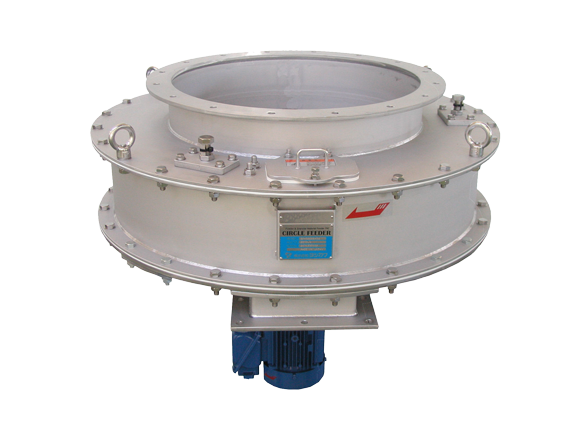
What is it
A Circle Feeder is a table-type powder feeder that mounts at the bottom of a hopper, bin or silo. Its round inlet is sized larger than the material's critical arching diameter, so bridges cannot form. Slow-rotating vanes move material outward under a fixed flow adjusting ring to one or more discharge ports, giving steady, first-in, first-out mass flow.
The same unit both discharges the hopper and meters material into the next step of your process, at a consistent rate. Every Circle Feeder LCI supplies is designed and engineered for your material and your process requirements.
Materials
Powders, granules, fibers, flakes and wet cakes
Flow pattern
Mass flow, first in, first out, with no material hold-up
Turndown
Up to 10:1 with a variable-speed drive; up to 20:1 adjusting ring height and speed together
Inlet size
Round openings up to 12 ft (about 3.7 m) in diameter
Temperature
High-temperature designs up to 500 °C (932 °F)
Lowest feed rate
As low as 1 ml per hour with the MicroDischarger
The unique design allows for first in, first out processing and can eliminate any problems with bridging or ratholing giving you smooth, steady discharge of all your materials.
Every Circle Feeder we provide is specifically designed and engineered to achieve your specific process requirements.
The Circle Feeder has a variety of features but widely known for its ability to prevent material arching, bridging, and ratholing.
In 1997 LCI Corporation formed a partnership with Yoshikawa Corporation. As a result of our partnership, LCI is the exclusive supplier to the process industries in North and South America for Yoshikawa's unique, patented Circle Feeder, the best solution for many difficult-to-flow solid materials.
Many feeding problems start in the hopper, not the feeder. When the outlet is narrower than a material's critical arching diameter, cohesive, sticky or fibrous particles can lock together and stop flowing, even though the hopper is full.
Material forms a stable arch over the outlet and flow stops. Plants often fall back on hammers, vibrators or air knockers to break it.
Material drains through a narrow channel above the outlet while the rest stays on the walls. Usable hopper capacity shrinks, and stagnant material can cake or degrade.
The inlet is wider than the critical arching diameter, so no arch can span it. Vanes draw from the full cross-section and the whole bed moves down evenly.
How it works
The design uses gravity and slow mechanical motion rather than force. Four parts do the work.
At the center of the feeder, flat vanes move material radially outward from the middle of the inlet.
Material passes beneath a fixed ring. Ring height is one of two ways to set capacity; shaft speed is the other.
In the outer channel, rotary vanes carry material around toward the outlet.
One or more ports release material to the next process. Several ports can feed separate downstream lines or split one stream.
The vanes turn slowly, at 0.05 to 7.2 rpm depending on the model, so the feeder runs quietly, handles products gently and needs little maintenance. As material leaves the outlet, the level in the hopper drops evenly, creating mass flow conditions.
Benefits
What each part of the design does for your process, from LCI's Circle Feeder technical bulletin and product literature.
| Feature | Benefit |
|---|---|
| Large round inlet, up to 12 ft in diameter | Exceeds most materials' critical arching diameter, so it prevents bridging and ratholing. Fits existing silos. |
| Patented mass flow design | No material hold-up in the hopper. First in, first out, which also prevents segregation. |
| Slow-rotating vanes | Gentle product handling, quiet operation, low maintenance and minimal downtime. |
| Simple design that uses gravity to help discharge | Low energy consumption. |
| Two-way capacity adjustment: flow adjusting ring height and shaft speed | Wide turndown: up to 10:1 with a variable-speed drive, and up to 20:1 using both adjustments. |
| Multiple discharge ports | Feed several downstream processes or split the process stream from one hopper. |
| Discharging and metering in one unit | A consistent discharge rate straight from the hopper. |
| Easily accessible motor and gearbox | Minimizes downtime for service. |
The Circle Feeder handles powders, granules, flakes, fibers and wet cakes, including sticky, fluffy, lumpy and flaky materials that defeat conventional feeders.
Products
Five versions of the same principle, from bench-top R&D to silo discharge and dust collector hoppers.
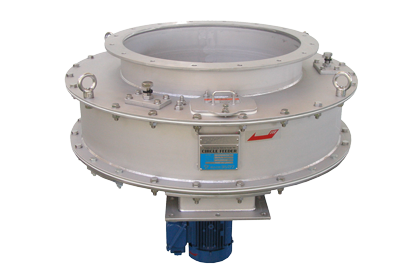
The industrial feeder and discharger for difficult materials. Standard models run from CF-500 to CF-2400, and models up to CF-4000 can be supplied.
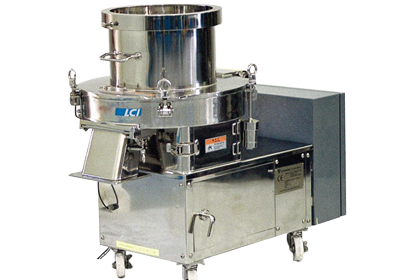
A clamshell design for complete cleaning, a 400-grit mirror finish, sanitary clamps and casters for moving in and out of clean rooms. The central vane comes out by removing one bolt. Suitable for powders or wet cakes.
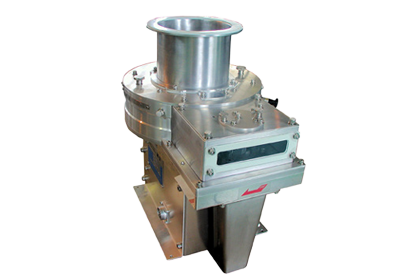
Combines a Circle Feeder with a disk feeder and replaceable scraper in one compact unit. It feeds powders with poor flowability without pulsation, at rates as low as 1 ml per hour. Models MD-120 and MD-180, in 304 stainless steel.
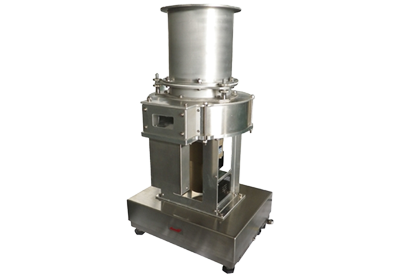
A compact bench-top unit that feeds very small quantities of difficult powders at a uniform rate. Use it for R&D or to evaluate the Circle Feeder before production scale. The speed-adjustable motor changes feed rate easily, and assembly takes minutes. A hopper is optional.
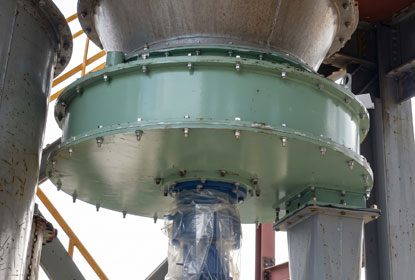
A Circle Feeder built to discharge dust collector hoppers. It stops bridging without vibrators, air knockers or replacement hoppers, handles sticky, fine and high-temperature dusts, and is available in heat-resistant designs up to 360 °C.
Every Circle Feeder LCI supplies is custom designed for your needs. Options include:
With manual or automatic slide gates, to feed several lines from one hopper.
For abrasive materials.
Including clamshell designs for easy cleaning.
For high-accuracy gravimetric feeding.
To suit the space under your hopper.
Designs up to 500 °C.
For wet cakes and other high-moisture materials.
For feeding pneumatic conveying systems.
For hazardous areas.
For high bulk density materials.
Comparison
LCI customers have used the Circle Feeder in place of screw, belt, rotary, bulk, hopper and weigh feeders. The main difference is where the flow problem gets solved.
| Approach | How it draws from the hopper | Common issue with cohesive, sticky or fibrous materials | Circle Feeder Solution |
|---|---|---|---|
| Screw feeder | Material enters the screw through a trough opening under the hopper outlet. | If the opening is narrower than the critical arching diameter, arches and ratholes can still form. A rotating auger can also overwork shear-sensitive materials. | A round inlet sized larger than the arching diameter, with slow vanes that handle material gently. |
| Rotary valve or rotary feeder | Pockets fill by gravity from the outlet above the valve. | Depends on material flowing freely into the valve. Sticky or fluffy materials can bridge above it or fill pockets unevenly. | Actively moves material from the full inlet area to the discharge port. |
| Flow aids: vibrators and air knockers | Added to hopper walls to break arches once they form. | Treat the symptom rather than the cause, and add noise, maintenance and wear. | Removes the cause, so flow aids and replacement hoppers are often unnecessary. |
Need gravimetric accuracy? A Circle Feeder can be supplied with load cells and loss-in-weight control, combining reliable discharge with weigh-feeder precision.
Case Studies
Two documented installations from LCI's case histories.
Synthetic paper recycling
Challenge
Granulated paper trimmings arched severely in surge silos. With a bulk density under 10 lb/ft³ they needed very large silos, and the process demanded steady discharge of about 10,000 lb/h. A single blockage meant manually removing and cleaning hundreds of feet of pneumatic tubing, shutting down the process.
Solution
After pilot testing, the customer bought four large Circle Feeders. The inlet matched the silo diameter, allowing straight-walled silos with no cone and much less headroom. Stoppers inside the hoppers kept the light paper from turning, so it moved in mass flow.
All four started up with only one issue, caused by a downstream malfunction, and run 24/7 to the original design. Feed rate can be varied reliably over a 10:1 range. During the same trials the customer also successfully tested micronized calcium carbonate and a cohesive titanium dioxide, and bought a Circle Feeder for each.
Agrochemicals: biological insecticide
Challenge
A Midwestern manufacturer needed to store a centrifuge wet cake and meter it into an extrusion process. A cone feeder with an internal auger overworked the cake, releasing bound water that made the material stick to the auger and bridge in the cone.
Solution
The test sample reached the LCI Test Center as a slurry, yet the Circle Feeder still discharged it without bridging. The trial feeder was then shipped to the plant, where its slow shaft speed and large inlet metered the cake uniformly.
Material that sat in the hopper for 24 hours could still be discharged, greatly reducing cleanout time after plant upsets. The result was higher productivity and better product performance.
Downloads
Technical bulletins and case histories for the Circle Feeder family.
Common things to know
Answers to common questions about the Circle Feeder
Connect with LCI to improve your process and schedule a feeding test.
Last updated: October 2026
Its round inlet is sized larger than the material's critical arching diameter, so a stable arch cannot span the opening. Slow-rotating vanes draw material from the full cross-section of the inlet, so the whole bed moves down evenly instead of flowing through a narrow channel. The result is mass flow: first in, first out.
Powders, granules, fibers, flakes and wet cakes, including sticky, fluffy, lumpy and flaky materials. Examples include starches, flours, pigments, polymer flakes, carbon black, metallic powders, sewage sludge, wood chips, biomass, fly ash, recycled plastic and paper, pharmaceutical ingredients and electric vehicle battery powders.
Yes. Round openings up to 12 ft in diameter fit existing silos, and the Circle Feeder for Dust Collectors (CFD) is designed to retrofit existing dust collector hoppers. In one installation the feeder inlet matched the silo diameter, which allowed a straight-walled silo with no cone and greatly reduced headroom.
Yes. The GMP Circle Feeder is built for pharmaceutical and other clean room applications. It has a clamshell design for complete cleaning, a 400-grit mirror finish, sanitary clamps for quick disassembly and casters for moving it in and out of clean rooms. The central vane comes out by removing a single bolt.
The MicroDischarger Circle Feeder feeds poorly flowing powders at ultra-low rates, as low as 1 ml per hour, without pulsation. For laboratory work, the bench-top Mini-Feeder handles very small quantities and can be used to evaluate the Circle Feeder before scaling up.
Yes. Speak with an LCI process engineer about your application, send a sample of your material to the LCI Test Center in Charlotte, North Carolina, and LCI engineers run a feeding test to confirm feasibility and collect scale-up data. You receive a report with test parameters, observations and recommendations.
Thin film evaporation, extrusion-spheronization, wet granulation, drug pelleting, and precision powder feeding. Fully staffed Test Center with scale-up support available in Charlotte, NC.