Segregation in multi-ingredient blends
Fine and coarse particles separate in transit, so one capsule carries more of an ingredient than the next.
Nutraceutical manufacturing
LCI builds nutraceutical powder processing equipment that turns supplement powders into round pellets and dense granules. Our extruders, Marumerizer spheronizers, pellet mills, Circle Feeder® feeders and DOME-EX systems give you uniform particle size, a tight size distribution, smoother mouthfeel and pellets that run clean through capsule, sachet and stick-pack fillers. Each comes in lab and production scale.
Last Updated: November 2026
Why particle engineering matters
Milled nutraceutical powders contain particles of many shapes and sizes. Those particles separate during handling, bridge in hoppers, throw off dust and feel gritty in the mouth. Turning the powder into round pellets of one size fixes these problems at the source, before the product reaches your filling line.
Supplement brands ask for more than a correct label claim. Buyers judge a sprinkle, gummy alternative or stick pack by how it pours and how it feels on the tongue. Contract manufacturers judge it by fill-weight rejects and line stoppages. Particle engineering moves both numbers.
Fine and coarse particles separate in transit, so one capsule carries more of an ingredient than the next.
Sticky, fluffy botanical powders arch over the outlet and starve the filler.
Fines coat equipment, cut yield and add cleaning time between product changeovers.
Irregular particles in sprinkles and direct-to-mouth powders leave a texture that consumers notice.
US dietary supplement manufacturers operate under 21 CFR Part 111, the FDA's current good manufacturing practice rule for supplements. LCI designs equipment for cleanability and product protection, with sanitary and cGMP construction options that support your quality system.
Extrusion-spheronization and continuous wet granulation give supplement makers four measurable gains: uniform particle size, a tight particle size distribution, smoother mouthfeel and better packaging performance in capsules, sachets and stick packs.
The extrusion die or screen sets every granule's diameter. The Marumerizer then breaks the extrudate into segments about one diameter long and rounds each into a sphere. You start with two fixed dimensions, so the finished pellets come out close to one size.
A narrow particle size distribution leaves fewer fines and fewer oversize pellets to screen out. LCI's pelleting process delivers narrow distributions with repeatable results from batch to batch, which raises yield on high-value actives.
Spheronization gives each pellet a smooth, round surface. Round pellets roll across the tongue in sprinkles, stick packs and chewables, where milled particles feel chalky or gritty. The same smooth surface takes thin-layer coatings that formulators use to mask bitter vitamins, minerals and botanicals.
Spheronization removes the sticking and bridging points that slow powder flow, cuts dust and fines, and raises apparent bulk density by up to 25% compared with extruded material. Free-flowing, dense pellets move through capsule fillers, sachet lines and stick-pack machines at a steady rate, so fill weights hold.
Extrusion spheronization
Extrusion-spheronization is a pelletization process with two shaping stages. An extruder forms the wet powder into cylinders of fixed diameter, then a spheronizer rounds those cylinders into spheres. LCI's extruders and Marumerizer spheronizers come from Fuji Paudal, the inventors of extrusion-spheronization technology.
A Circle Feeder discharges and meters the powder blend in mass flow, with no bridging or ratholing.
A kneader or high-shear granulator blends powder and liquid into a uniform wet mass. DOME-EX runs this step as a continuous process.
The extruder pushes the wet mass through a die or screen to form cylinders of one diameter.
The Marumerizer's spinning friction plate breaks the cylinders into short segments and rounds each into a sphere.
You dry the pellets, add a functional or taste-masking coat if needed, and send them to capsule, sachet or stick-pack filling.
Supplement manufacturing equipment
LCI supplies five powder handling technologies for nutraceutical manufacturing: extruders, Marumerizer spheronizers, flat-die pellet mills, Circle Feeder feeders and the DOME-EX continuous wet granulation system. Each comes in lab scale for formulation work and production scale for commercial output.
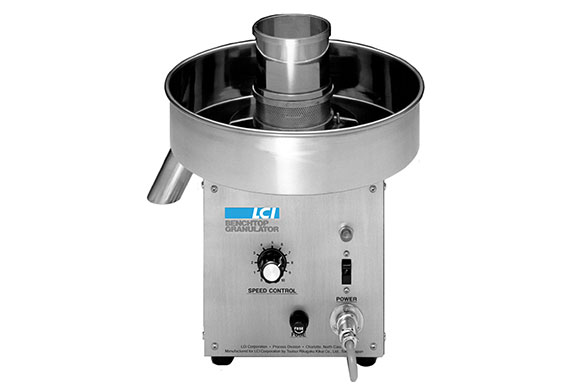
Wet extrusion converts wet powders into free-flowing granules. The Basket Granulator™ is the lowest-pressure extruder LCI offers, and the TDG-60's dome die matches the lab-scale MG-55 for predictable scale-up. The Xtruder™ Radial offers a cooling option for temperature-sensitive material.
MG-55 Multi Granulator (0.6–8.0 mm);
BR-150 Basket Granulator;
Benchtop Granulator BTG (KAR-75), 100 g minimum
TDG-60 (0.3–2.0 mm);
Twin Dome Granulator™;
Basket Granulator™;
Xtruder™ Radial (0.5–2.0 mm) and Axial (2.0–8.0 mm)
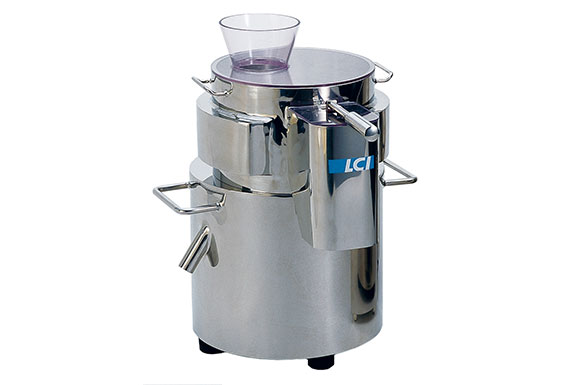
The Marumerizer converts wet extrudate into spheres from 0.5 mm to 10.0 mm. Spheronized pellets have a smooth surface for thin-layer coating, a consistent shape, less dust and fines, better flow and up to 25% higher apparent bulk density than extruded material.
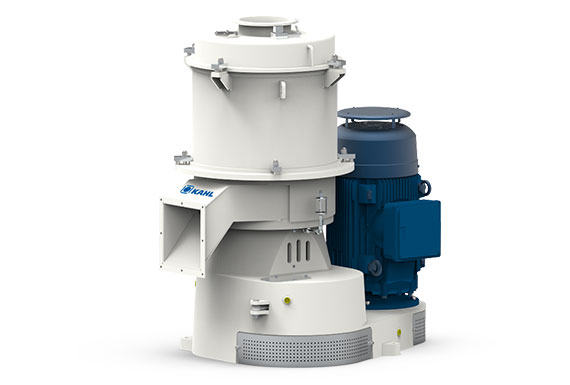
Kahl flat-die pellet presses form dense, uniform pellets from 2 mm to 8 mm. Rollers press material through a static die plate, and you set densification by changing the compression distance. The press suits products with high slipping properties and melting points below 40°C. A flat-die press can also pre-compact ingredients ahead of tableting.
Lab pellet press for formulation trials
Kahl flat-die pellet presses, including model 14-175; 2–8 mm die plates
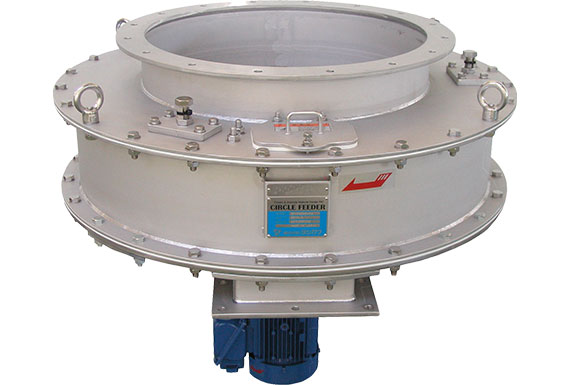
The Circle Feeder discharges and meters sticky, fluffy, lumpy, flaky and fibrous materials, such as botanical powders and fiber blends. A large round inlet and slow vanes keep material in first-in, first-out mass flow with no bridging, ratholing or segregation. Turndown reaches 20:1.
Bench-top Mini-Feeder;
MicroDischarger MD-120 and MD-180, down to 1 ml per hour
Circle Feeder CF-500 to CF-2400 (up to CF-4000);
GMP Circle Feeder CS series
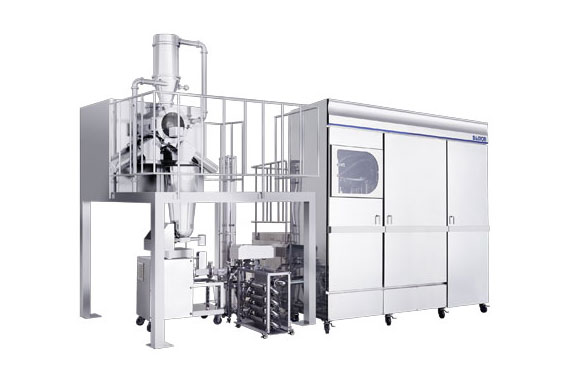
The DOME-EX blends, kneads, extrudes and dries in one continuous line, replacing slow batch granulation in high-shear and fluid bed granulators. Twin screws knead the powder with liquid from a peristaltic pump, then carry it into a vertical dome die that forms fine, dense, cylindrical micro-granules of uniform diameter and hardness.
Use DOME-EX granules for pre-compaction ahead of tablet pressing, or as feed for spheronization.
DOME-EX lab configuration for formulation trials at the LCI Test Center
DOME-EX at 10–25 kg/hr; 0.2 and 0.3 mm dome dies; 316SS product-contact parts; PLC/HMI touchscreen
Many nutraceutical actives start as liquid extracts that degrade under prolonged heat. LCI thin film and short path evaporators expose the product to heat for a short residence time, so you can concentrate, purify and strip solvents from heat-sensitive extracts before they move to drying, blending or pelletizing.
A rotor spreads the product into a thin, turbulent film on a heated wall. Short residence time and narrow residence time distribution protect temperature-sensitive products from foaming, fouling and degradation.
Short path evaporation, also called molecular distillation, runs at vacuum down to 0.001 mbar with an internal condenser. It processes heat-sensitive, high-boiling products such as natural extracts and specialty oils. A lab-scale short path unit supports trials.
Supplement formats
Spheronized pellets and extruded granules work in most solid supplement formats: pellet-filled capsules, sprinkle sachets, stick packs, tablets and beadlets. Pellets also let you combine ingredients that react with each other by keeping them in separate pellet populations.
Fill hard capsules with coated or uncoated pellets, including enteric-coated and timed-release pellets, or blend several pellet types in one capsule.
Taste-masked pellets that consumers pour onto soft food. A good fit for people who struggle to swallow capsules or tablets.
Free-flowing, low-dust pellets fill narrow stick packs at steady weights and pour without clumping for direct-to-mouth use.
DOME-EX micro-granules and flat-die pre-compaction prepare ingredients for tablet pressing. Coated pellets can go inside disintegrating tablets.
Small, round beadlets carry actives into blends, fortified foods and premixes, with less segregation than powder.
Pellet incompatible ingredients in separate batches, then combine them in one capsule or sachet so they stay apart until consumption.
Comparison
Spheronized pellets give a narrower particle size distribution, better flow, less dust and a smoother surface than milled powder or granules from high-shear and fluid bed granulators. Milled powder skips the pelletizing step but carries the highest risk of segregation and fill-weight variation.
| Property | Milled powder | Conventional granules | Spheronized pellets |
|---|---|---|---|
| Particle shape | Irregular | Irregular, porous | Round with a smooth surface |
| Particle size distribution | Broad | Moderate to broad | Narrow |
| Flowability | Poor to fair; bridges in hoppers | Fair to good | Good; no sticking or bridging points |
| Dust and fines | High | Moderate | Low |
| Segregation risk in blends | High | Moderate | Low |
| Coating suitability | Poor | Uneven coat thickness | Even thin-layer coating |
| Mouthfeel in sprinkles and stick packs | Chalky or gritty | Rough edges | Smooth |
Qualitative comparison for nutraceutical solid dose. Performance depends on formulation; confirm with a Test Center trial.
LCI Test Center — Charlotte, NC
The LCI Test Center in Charlotte, North Carolina has lab and pilot-scale equipment for nutraceutical trials. LCI's lab extruders and spheronizers produce material representative of full-scale production, so the pellets you approve in the lab match the pellets your production line makes.
Preliminary Evaluation Study: LCI engineers review your formulation and targets and check whether LCI technology fits.
Pilot Plant Test: You attend a pilot run that produces qualification samples, scale-up design data and confirmed operating conditions.
On-site trial or purchase: Lease equipment short-term for trials at your plant, or move straight to a production system.
Common things to know
Answers to common questions about the Circle Feeder
Most nutraceutical pellet lines combine four steps: a feeder meters the powder, a mixer or kneader wets it, an extruder forces the wet mass through a die or screen, and a spheronizer rounds the extrudate into spheres. LCI supplies each step: Circle Feeder feeders, the DOME-EX kneader-extruder, Fuji Paudal extruders and Marumerizer spheronizers, plus Kahl flat-die pellet mills for dense cylindrical pellets.
Extrusion fixes two dimensions of every particle before spheronization starts: the die sets the diameter, and the spinning plate breaks the extrudate into lengths close to that diameter. Each piece then rounds into a sphere of near-equal size. Milling and high-shear granulation start from random particle sizes, so their output covers a wider size range.
Round pellets with a smooth surface roll across the tongue, where irregular milled particles feel chalky or gritty. Spheronization also gives each pellet a surface suited to thin-layer coating, which formulators use for taste masking. Results depend on the formulation, so LCI recommends a Test Center trial before you commit to a format.
Spheronization removes the sticking and bridging points that slow powder flow, cuts dust and fines, and can raise apparent bulk density by up to 25% compared with extruded material. Free-flowing, uniform pellets move through filling equipment at a steady rate, which helps you hold fill weights in capsules, sachets and stick packs.
Yes. The LCI Test Center in Charlotte, North Carolina runs a Preliminary Evaluation Study to check whether LCI technology fits your formulation, then a Pilot Plant Test that produces qualification samples and scale-up data. You can attend the pilot test. Short-term equipment leases are also available for trials at your own plant.
Yes. LCI thin film evaporators purify botanical extracts and oils and strip solvents from temperature-sensitive products. For high-boiling, heat-sensitive extracts, LCI short path evaporators run at vacuum down to 0.001 mbar with a short residence time.
Connect with LCI to improve your process and schedule a test.
Thin film evaporation, extrusion-spheronization, wet granulation, drug pelleting, and precision powder feeding. Fully staffed Test Center with scale-up support available in Charlotte, NC.